
Exmoor Ponies: Where To See Them in Exmoor National Park

Native to the moors of west Somerset and north Devon, Exmoor Ponies are the region’s most adorable locals. Small, hardy, and thought to be the oldest pony breed in Britain, these animals roam freely throughout Exmoor National Park.
Exmoor Ponies nearly became extinct during World War II. Rustled for meat and used by soldiers for target practice, only about 50 were left by the end of the war. Thankfully, numbers have since rebounded to approximately 500 on Exmoor and 3,500 worldwide, due to the incredible efforts of the Exmoor Pony Society and Moorland Mousie Trust.
Today, locals recognise the importance of these ponies in maintaining the land, and cherish their place on the moors. For people visiting Exmoor National Park, seeing these iconic ponies roaming free is top of their bucket list.
Read on to learn how to identify the breed and discover where to see Exmoor Ponies while visiting Exmoor National Park.
A brief introduction to the Exmoor National Park
The Exmoor National Park is an area of moorland located in west Somerset and north Devon in South West England. It gets its name from the River Exe, the source of which can be found in the centre of the national park.
At just 693 square kilometres, Exmoor is one of the UK’s smallest national parks. But what it lacks in size, it makes up for in wildlife and beautiful landscapes, boasting open moorland, winding country roads, quaint villages and a dramatic coastline.

How to identify an Exmoor Pony
So, how do you recognise an Exmoor Pony? Well, they’re actually very distinctive.
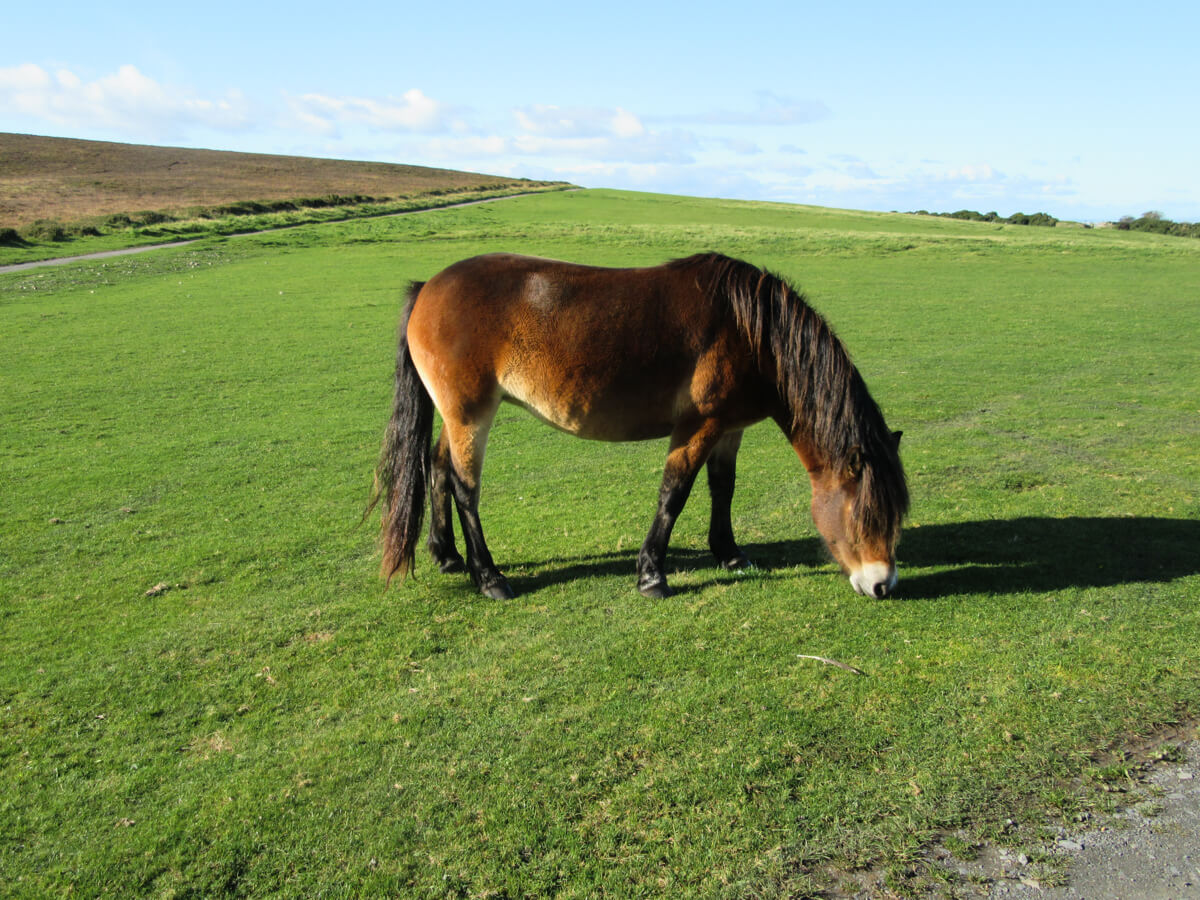
All Exmoor Ponies are brown with mealy colouring around their eyes and muzzle. It’s this mealy colour that makes them identifiable from other breeds. They’re also short and stocky, with a deep chest, large girth and a thick mane.
The Domesday Book mentions the Exmoor Pony, which suggests that the species is one of Britain’s original pony breeds, dating back to at least the 11th century.
As you would expect from such an old breed, Exmoor Ponies have adapted to their environment and are perfectly built for life on the open moorland.
To survive the cold winter months, Exmoor Ponies grow a thick coat made up of two layers. The hairs next to their skin are fine and form a layer of insulation, whereas the outer hairs are coarse so that rain runs down them, rather than soaking them.
You can see just how efficient their winter coats are when it snows. Snow will collect on the ponies’ coats because they don’t lose enough body heat to melt it!
Where to see Exmoor Ponies
According to the Exmoor National Park Authority, there are currently 19 free-roaming registered herds on Exmoor. These herds aren’t truly wild — all are owned and managed by someone — but as free-roaming animals, they might as well be.
As the ponies wander, it’s hard to pinpoint precisely where you’ll find them, but the herds do typically roam designated areas of the moor. If you head to the right places, you have a good chance of spotting them.
Some likely Exmoor Pony sighting locations include:
- Winsford Hill (home to the oldest and largest herd of registered ponies)
- Porlock Hill
- Molland Moor
- Withypool
- Codsend
- Dunkery Beacon
- Valley of the Rocks
- Haddon Hill
- Countisbury
- Brendon Common
- I spotted my first Exmoor Ponies at Foreland Point
The Exmoor Pony Center in Dulverton
If you want to be guaranteed to see Exmoor Ponies, head to the Exmoor Pony Centre near Dulverton. Founded in 1998, the centre works to promote, protect and conserve the breed.
The Exmoor Pony Centre is home to about 20 ponies, some of which are available for visitors to meet in the yard and paddocks. Admission is free, but donations are very much appreciated to help with the costs of caring for the ponies.
The Exmoor Pony Centre
Address: Ashwick, Dulverton, Somerset, TA22 9QE
Tel: 01398 323093
Thank you for reading! If you found this post useful, I’d be grateful if you would consider using the affiliate links below when planning your travels. I’ll make a small commission at no extra cost to you. This will help me to keep this blog running. Thanks for your support — Lauren.
Accommodation – Booking.com
Flights – Booking.com
Travel insurance – World Nomads
Excursions & tours – Viator
Outdoor gear – Decathlon
eSIMs – Airalo
Alternatively, you could buy me a coffee to say thanks!


About The Author
Lauren Pears is a freelance travel writer and blogger who writes about active adventure travel. She’s been blogging for almost 10 years, and has written for publications such as Lonely Planet, World Nomads, and Southeast Asia Backpacker.


